By NOREEN TONER
Entertainment Writer
GLASSBORO — Happy 25th Birthday, WGLS — 89.7 on the FM dial.
We interrupt this moment to bring you a news flash from January, 1965: WGLS, Gloucester County’s only radio station, is on the air at Glassboro State College. Broadcasting from Bunce Hall with low watts of power, 500-foot headless cord to hear such live programs as the Glassboro Board of Education conducted their meetings.
Things sure have changed in 25 years. WGLS — still the only radio station in the county — is now a voice that broadcasts music, news, sports, community and public service news to people in three states.
The station is 210 watts strong (at night that’s comparable to most college stations), has an 85-foot high transmission tower, one on-air studio, one back-up studio, a conference room and a news/sports room.
And, although no one seems to know what the station’s starting budget was in 1965, the budget rose from $10,000 in 1975 to about $70,000 this year.
Although these figures make the station seem all grown up, it’s really just a pup.
WGLS has not been without its share of growing pains.
There were times when the station did not get the funds and equipment it needed due to college budget uncertainties. The station wasn’t even a decade old when its future existence became questionable.
“Coming out of the ’60s, it was freaked out. They were beating each other up on the air (and doing other crazy things) … There were problems with the station … the school thought it was more of a drain than it was worth,” said GSC Communications professor Michael Volivas.
In 1973 or 1974, things changed. Donovan became the station’s part-time advisor, a position he held until recently. Last year, the college hired the station’s first full-time advisor, Phyllis West.
Shortly after Donovan was first hired, the New Jersey Public Broadcasting Authority recommended WGLS increase power to 1,000 watts. Although the radio studios would have remained in Glassboro, Donovan said the plan was nixed because it was unfeasible.
The Glassboro studios were slated to be moved to new, larger space on someone’s current antenna to put up your antenna,” said Donovan.
The appointment of Donovan, as well as the contributions by other faculty/staff members, ushered in a period of immense growth and change for the station that can still be felt today.
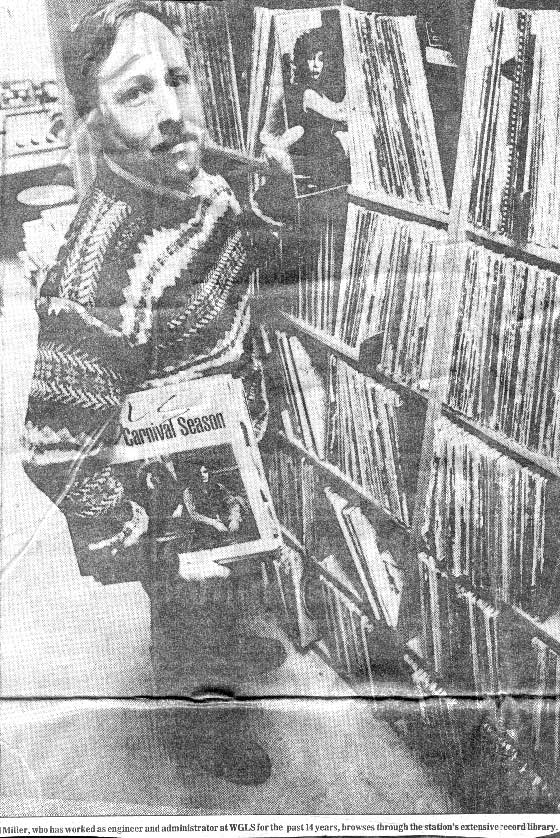
For instance, station engineer and administrator Al Miller, who came on the staff 14 years ago, developed a study format for students to obtain their FCC licenses.
To start their FCC training, students begin the first level of training by working various jobs around the station. They work in the news, sports, music, or public relations departments — doing everything except engineering on the air. At the end of level one, students must get a form signed by the head of the department where they volunteered.
The FCC training, which is free and open to any GSC student, includes three, 1½-hour classroom sessions with a training book, hands-on training in the studios, and a written and hands-on exam.
The same testing process is repeated in the second level of training, which also includes further study of FCC rules, how to operate the transmitter, and other technical duties.
When the second level of instruction is successfully completed, students take an FCC written exam. If a student passes, he or she receives an FCC license.
“When I got my FCC license it was a huge accomplishment,” said GSC student Larry Narbone, 20, who compared the training to pledging for a fraternity.
“You have to go through all the pain of working in the department, getting your signature, trying to make a good impression, learning how to sound good on the radio,” plus studying the book,” he said. “All that hard work is worthwhile.”
A recent format change at the station, however, has prompted some conflict among students.
Since about 1985, the station has primarily played alternative-type music, the non-mainstream rock and roll, which at one time included music by the (now popular) groups U2 and R.E.M., to relatively unknown groups such as The Pixies and Concrete Blonde.
The trend for college stations to play alternative music is a national one, with many college stations receiving acclaim for their innovative programming and direction. In addition, such magazines as Rolling Stone and Spin — and even cable’s MTV — research and report on the “college charts” alternative music scene.
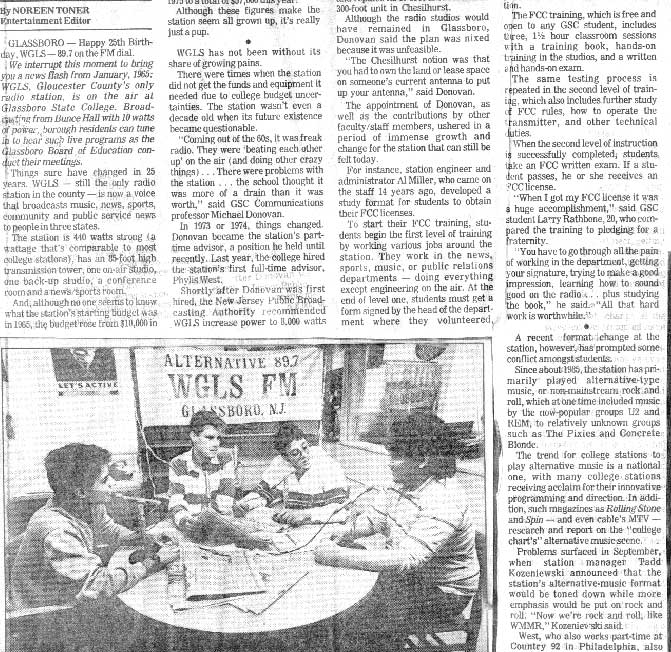
Problems surfaced in September, when station manager Todd Kozniewski announced that the station’s alternative music format would be toned down while more emphasis would be put on rock and oldie, “now we’re rock and roll, like WMMR,” Kozniewski said.
West, who also works part-time at Country 92 in Philadelphia, changes she instituted include the mandate that no records the obscenities be aired. West also said she completely supports the format switch.
“We haven’t neglected anyone. We’re weaving a bit of that alternative music into the format,” said West, who also teaches radio at GSC.
Generally speaking, students who support the alternative format do so because they believe it provides experimentation, learning, and gives exposure to new bands.
“Last year in the format I was alternative. When I became this year I noticed the WMMR/WXPN-type format,” said Jim Connolly, who has worked as a disc jockey at the station for the last year and a half. “The purpose of college radio is to play new music — not exploitation music,” he said.
“I think we should take some chances,” Connolly said.
Todd Kozniewski, 20, who is the station’s public relations director, said students who support the rock and roll format say it appeals to more people and it’s more like “the real world,” referring to the radio markets these students may be working in one day. They also complain that one type of music, they have been forced to play music they didn’t like.
“I can’t do it. The alternative music,” said Ksenia Ketsel, station manager. “I used to pick albums by bands whose names I couldn’t pronounce,” she said.
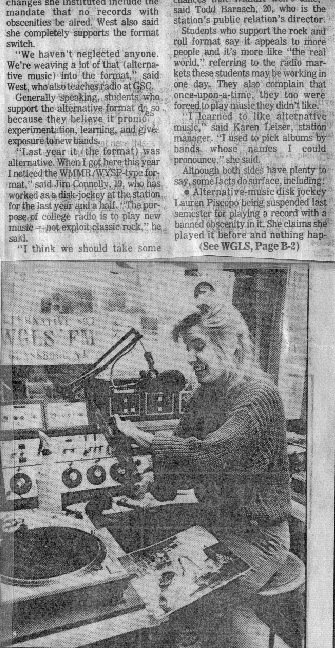
Although both sides have plenty to say, some facts do surface, including 85 alternative records the jockey Lauren Piscopo being suspended last semester for playing a record with a bleeped obscenity in it. She claims she played it before and nothing happened.
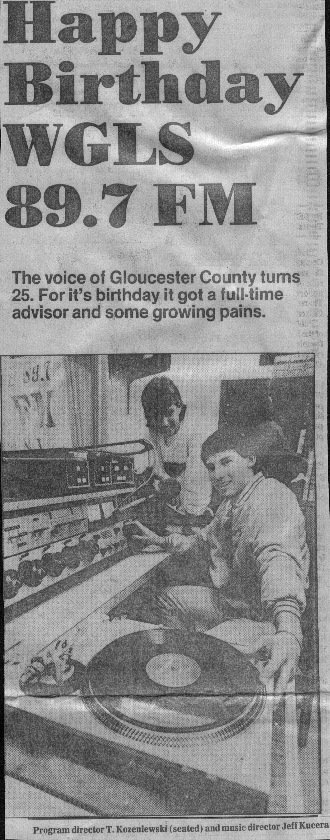
Happy Birthday WGLS 89.7 FM
The voice of Gloucester County turns 25. For its birthday it got a full-time advisor and some growing pains. Program director T. Kozniewski (seated) and music director Jeff Kucera.